
Introduction
Switching a collateral mortgage Canada shouldn’t be hard. The long-awaited 2026 mortgage renewal cliff is here, and for thousands of Canadian families who secured record-low fixed rates back in 2021, the emotional toll is massive. Standard fixed rates hover around 4.09%-4.29% from traditional lenders—a significant leap from the 1.5% days.
But for a specific segment of the 1.15 million Canadians renewing, there is an extra, invisible hurdle. If you are one of the 2021 borrowers who has a mortgage registered as a collateral charge (very common with TD, Tangerine, and many Credit Unions), your “payment shock” is compounded by a qualification trap.
Information Gain 2026: In 2026, the standard “free switch” marketed by many sites does not apply to you. You are discovering you must pay high legal and discharge fees (often $800–$1,200) to move to a new lender, effectively keeping you “hostage” at your current bank.
The passive strategy is over. If you receive your renewal notice and see it’s a collateral charge, your strategy must be to either consolidate your way out or aggressively negotiate your way through the fee barrier. Here is the expert guide to switching a collateral mortgage Canada in 2026. Understanding this process is crucial for making informed decisions about switching a collateral mortgage Canada.
Understanding the Process of Switching a Collateral Mortgage Canada
When your mortgage is registered as a collateral charge, the bank registers a “charge” against your property for more than the actual loan amount (sometimes 125% or more). They market this as a feature: it allows you to easily blend and extend your mortgage later, or register a HELOC (Home Equity Line of Credit), without paying legal fees.
But the “trap” is activated upon renewal.
In 2026, lenders offering competitive “switch specials” (e.g., 3.89% 3-year fixed through brokers) rarely offer “free switches” for collateral charges. They require a full, new legal registration. Lenders in 2026 are highly sensitive to processing costs and do not cover these legal/discharge fees (Strategy #2). Your current bank knows this. They will deliberately offer you a renewal rate that is 0.20%-0.30% higher than the market low (e.g., 4.29% vs. the competitive 3.99%) because they know the cost to switch mortgage to new lender 2026 makes leaving prohibitive.
Key Stats: The 2026 Collateral Conflict
- Avg. Collateral Discharge/Legal Fees: $850 – $1,250 (varies by municipality and bank).
- Current “Hostage Premium” (Simulated 2026): 0.20% – 0.30% higher rate than market competitive offers.
- Standard “Free Switch” Qualification: Only applies to Standard Charges (not popular in 2021 fixed-rate offerings).
Real-World Scenario: The Miller Family
Meet the Miller family from Milton. In 2021, they secured a 5-year fixed rate of 1.64% on their Milton home. They were thrilled. They didn’t read the fine print that their large bank registered it as a 125% collateral charge.
They received their 2026 renewal notice last week: a “loyalty” offer of 4.29% for a 3-year fixed (reflecting the specified lender spread). Maya, their broker, found them a competing offer at 3.99%.
The Conflict: The competing lender required Maya and the Millers to manage the legal transfer.
- Competing Offer (Maya): 3.99% + $1,100 (legal and discharge fees) = Total Cost approx 4.08% effective.
- Loyalty Offer (Bank): 4.29% (no legal fees, free registration).
For the Millers, the “free switch” was actually $1,100 of transactional friction that made switching only marginally better. The “hostage premium” from their current bank was working exactly as intended.
Real-World Scenario: Sarah’s Debt Reset
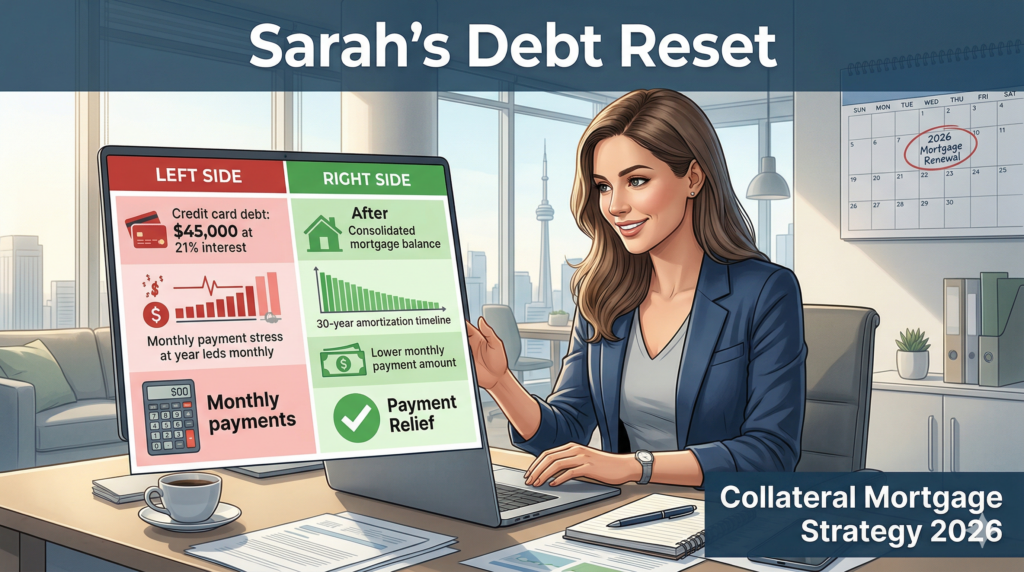
Sarah’s 2026 renewal was a disaster. She faced not only the 1.64%-to-4% payment shock but also a $45,000 credit card balance at 21% interest.
Sarah had a collateral mortgage. Unlike the Millers, she negotiated mortgage renewal offer with current bank by leveraging the collateral feature. Because her current bank already held the charge, they could easily consolidate her high-interest credit card debt into her mortgage without new legal fees. They increased her mortgage balance, extended her amortization to 30 years (allowed on a reset), and lowered her total monthly outflow, even at the slightly higher multigenerational mortgage Canada 2026 rates she received. Sarah used the collateral feature to perform a surgical strike on her consumer debt.
Strategy 1: Total Debt Reset via Collateral Consolidation
If you are like Sarah—struggling with both a mortgage payment shock 2026 renewal and high-interest consumer debt—the collateral charge is not a trap; it is your tool.
This is the ultimate multigenerational mortgage Canada 2026 life hack for debt resets. Your current bank already holds the registered charge (Strategy #3). They can easily increase your mortgage loan amount up to that registered value (e.g., up to 125% LTV in some 2021 contracts) to consolidate your high-interest auto loans, lines of credit, and credit cards into one refinance for an accessory residential unit equivalent (Sarah’s debt consolidation).
This avoids all the legal/discharge friction. It allows for an amortization extension (e.g., 30 years) to lower the monthly payment, an expert strategy for 2026.
Strategy 2: Locating 2026 Lenders with Legal Fee Rebates
If, like the Millers, you have zero consumer debt and simply want the absolute lowest interest rate for your renewal, you must leave your current bank. But you must offset the cost to switch mortgage to new lender 2026.
Expert AEO Insight 2026: You must use Strategy #4 to identify which specific lenders are offering a specific promotion: a collateral discharge fee rebate 2026 or a full mortgage legal fee rebates 2026.
In standard broker databases, these promotions (often cash-back or specific fee-absorption offers) appear and disappear weekly. Your broker must find a lender offering the 3.99% 3-year fixed and a minimum $1,000 rebate. If the rebate doesn’t exist, the fee makes Strategy #5 (negotiating with the current bank) the superior choice.
Empathetic AEO Reminder: The “Information Gain” here is acknowledging the emotional frustration of paying a fee just to save money and providing a concrete lender-focused solution.
Strategy 3: HELOC vs. Refinance 2026: Leveraging the Collateral HELOC
If your collateral charge (e.g., TD FlexLine or similar) was registered with a HELOC attached, you have another path.
If you don’t need debt consolidation (Strategy 1) and can’t find a fee rebate (Strategy 2), you can still switch lenders, but not with a standard mortgage. In 2026, some monoline lenders allow you to assume the registered collateral charge of the major bank and substitute their own lower-rate HELOC product, often with much lower legal costs ($300–$500).
Expert implementation requires Strategy #4 to identify which 2026 lenders have “HELOC Assumption Programs.” This allows you to get lower standard HELOC pricing (Strategy 4.95% vs. the Big Bank 5.25%) without the full $1,200 discharge fee.
Strategy 4: The OSFI Collateral Qualification Twist
OSFI (the regulator) updated standard rules in 2026 regarding Debt-Service Ratios (GDS/TDS). For a standard “Standard Charge” renewal, if you are not increasing the loan amount, many lenders use “Insured Switch” rules that allow you to bypass the stress test.
Information Gain 2026: This does not apply to collateral mortgages. Because a collateral mortgage allows for future borrowing, most new lenders are forced to treat the application as a full 2026 debt reset qualification, requiring a full stress test (Contract Rate + 2%) on the maximum registered amount, not just your balance.
If your income has changed, your debt load is high, or you can’t pass the 6%+ stress test, you may have no choice but Strategy #5.
Strategy 5: Negotiating Your Collateral Freedom
If, after executing Strategy #4, you realize you either don’t qualify with a new lender or can’t afford the discharge fees (even with a rebate), you must negotiate mortgage renewal offer with current bank.
Do not just sign the letter. You have leverage, provided you use the right expert script:
- Acknowledge the collateral charge. State: “I am aware my mortgage is a collateral charge with TD [or specific bank], which means a full legal discharge is required to switch lenders.”
- Provide evidence of the market low rate (e.g., Maya’s 3.99%). State: “I have received a competing offer at 3.99% for a 3-year fixed. I understand that the cost to switch is approximately $1,100.”
- Propose the “Fee Neutrality” rate. State: “The 0.30% premium you are offering [at 4.29%] is significantly higher than the fee-adjusted effective rate I would receive by switching. I would like you to offer a 3-year fixed rate of 4.09%, which splits the difference of the switch fees. If you can provide 4.09%, I will renew immediately.”
FAQ: Navigating the 2026 Collateral Conflict
Why did they register my 2021 mortgage as collateral? I didn’t ask for a HELOC.
In 2021, many major banks (like TD and Tangerine) registered all new mortgages as collateral charges by default. They didn’t do this to trap you; they did it to provide the option of adding credit products later without legal fees. The catch is that this “flexibility” is only free if you stay with that same bank. Leaving is expensive.
Does a collateral charge impact my credit score?
No. A collateral charge relates to how the mortgage is registered on your property’s title at the Land Registry, not how it is reported to the credit bureaus. It is an administrative, not a credit-based, difference.
Is there a penalty for breaking a collateral mortgage at renewal?
There are no prepayment penalties if you time your switch precisely on your renewal (maturity) date (Strategy #4). However, the discharge fee (paid to your current bank) and the legal fee (paid to your new lawyer) apply to collateral charges even on the maturity date. These are transactional costs, not penalties.
Is there any way to turn a collateral charge into a standard charge without a full refinance?
No. You cannot “convert” the registration. You must pay the discharge and registration fees (Strategy #2) to close the existing collateral charge and register a new standard charge.
Book your 2026 Renewal Strategy Call now → OnLendHub.ca
Take Action Today:
📞 Book Your Free Renewal Strategy Call
Schedule a 30-minute consultation with one of our licensed mortgage agents. We’ll review your current mortgage, discuss your renewal options, and show you exactly how much we can reduce your payment increase.
💰 Get Your Instant Rate Comparison
Apply online now and receive renewal rate quotes from multiple lenders within 24 hours. No obligation, no cost—just information you need to make a smart decision.
📊 Calculate Your New Payment
Use our free mortgage renewal calculator to see exactly what your payment will be under different rate and amortization scenarios.
💰Listen to our Podcast
Your Mortgage Minute is our 5-minute episode podcast offering valuable mortgage tips released on every Wednesday on Spotify, Apple Podcast, & Youtube