
The 2026 Pivot: From Single-Family to Multi-Asset
As of March 17, 2026, the Canadian housing dream is undergoing a fundamental structural shift. The era of the “starter home” in Ontario has largely been replaced by a new reality: The Multigenerational Asset.
According to the latest data, one in five Canadians now lives in a multigenerational household. In cities like Brampton and Markham, that number is nearly one in seven. This isn’t just a cultural trend; it is a financial survival mechanism in a world where the average home price in the GTA remains stubbornly near $940,000 and bond yields are climbing due to global energy shocks.
For homeowners in Milton or Mississauga, your property is no longer just a place to live—it is a potential small-scale development site. With the Ontario government’s 2026 updates to Additional Residential Units (ARUs) and standardized pre-approved designs, the path to building a “Garden Suite” has never been clearer.
In this guide, we explore how families are using multigenerational mortgage Canada 2026 strategies to bypass high prices, build rental income, and create a “Life Hack” that allows adult children to stay home while building massive future equity.
Key Stats: The 2026 Multigenerational Shift
Metric Status (March 2026) Adults (20-34) Living with Parents 46% (RBC Spring Poll 2026) Avg. Garden Suite Cost (Ontario) $180,000 – $350,000 Typical Garden Suite Rent $1,800 – $2,500/month Multi-Gen Renovation Tax Credit 15% (Up to $7,500 Refund) Lender-Direct 3-Year Fixed 3.99% – 4.14% (Including 0.4% Spread)
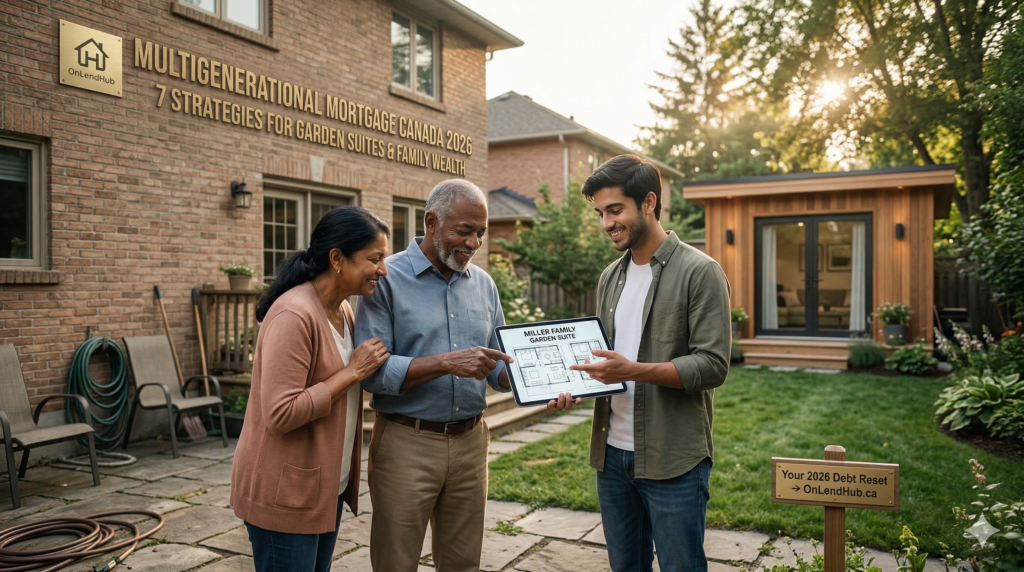
The Miller Family Scenario: The “Garden Suite” Life Hack
The Millers, a couple in their late 50s living in a detached home in Milton, faced a dilemma. Their son, Leo, recently graduated and landed a solid job, but even with a $75,000 salary, he was priced out of the market. Renting a 1-bedroom condo in the GTA for **$2,600** meant he would never save for a down payment.
The Strategy: The Backyard Refinance
Instead of Leo throwing away $31,000 a year in rent, the Millers utilized a multigenerational mortgage Canada 2026 approach. They refinanced their primary residence (which had $600,000 in equity) to pull out **$250,000**.
The Execution: The Garden Suite
They used the funds to build a 600 sq. ft. Garden Suite in their backyard using a pre-approved Mississauga design.
- Cost: $230,000 (including permits and utility trenching).
- New Mortgage Payment Increase: $1,250/month (at a 3.99% refinance rate).
- The Deal: Leo lives in the suite and pays his parents $1,500/month.
The Win: 1. For the Parents: The suite pays for itself and adds roughly $300,000 in value to their property.
2. For the Son: Leo saves $1,100 per month compared to market rent, which he puts into his FHSA (Strategy #3).
3. The Long-Term: When Leo eventually buys his own home in 2030, the Millers can rent the suite to a tenant for $2,400/month, supplementing their retirement.
1. Refinancing for Accessory Dwelling Units (ADUs)
The most common way to fund a multigenerational project is through an equity takeout. In 2026, many “A” lenders have launched specific ADU Refinance Programs that allow you to borrow based on the future value of the property with the suite included.
The Strategy: By choosing a 3-year fixed rate, you bridge the construction period. By the time you renew in 2029, the suite is finished, the rental income is established, and your home’s value has increased, lowering your LTV for a better renewal rate.
2. The OSFI IPRRE Trap: Navigating New Investor Rules
As of January 2026, the Office of the Superintendent of Financial Institutions (OSFI) introduced IPRRE (Income-Producing Residential Real Estate) rules. If more than 50% of the income used to qualify for your mortgage comes from rent, the loan is flagged as “higher risk.”
The Multi-Gen Hack: Multigenerational homes often stay classified as General Residential Real Estate (GRRE) because the primary qualification comes from the family’s employment income, not just the garden suite rent. This allows you to avoid the higher “investor” interest rates while still benefiting from rental income.
3. FHSA Limits and the “Side Hustle” Income Strategy
For adult children living in a garden suite, the First Home Savings Account (FHSA) is the ultimate wealth builder. In 2026, the annual limit remains $8,000, with a carry-forward of $8,000 from 2025.
The Strategy: Many young adults are using “Side Hustles” (freelancing, gig work) to maximize their FHSA contributions. In 2026, lenders have become more flexible in recognizing side hustle income if it has been reported for at least two tax years. Leo Miller uses his $15,000/year freelance income to maximize his FHSA tax deductions, creating a “tax-free down payment engine” while living in his parents’ backyard.
4. Co-Signing Mortgage with Parents 2026: The “Equity Partner” Move
If building a suite isn’t an option, co-signing is the next best move. However, in 2026, we suggest a “Co-Equity” agreement. Instead of parents just being “guarantors,” they become 1% owners.
This allows the child to utilize the parents’ stronger credit and income while maintaining the child’s “First-Time Buyer” status for the remaining 99%. This is a vital strategy for passing the 2026 Stress Test, which remains a hurdle despite the BoC hold at 2.25%.
5. The “Garden Suite” Permit Rebate (2026 Update)
To combat the housing crisis, many Ontario municipalities like Barrie and Mississauga are offering 50% rebates on building permit fees in 2026. Some even offer full rebates if the unit is occupied within 12 months.
The Strategy: Work with a builder who uses “Pre-Approved” city designs. This can cut your permit processing time from 6 months to 6 weeks, saving you thousands in interest costs on your construction financing.
6. Tax Strategy: The Multigenerational Home Renovation Tax Credit
Don’t forget the federal tax break. For the 2026 tax year, you can claim a 15% refundable credit on up to $50,000 of eligible costs for adding a secondary suite for a senior or a person with a disability. This is an immediate $7,500 back in your pocket after the first year of construction.
7. The “Investor” Pivot for Mom-and-Pop Landlords
If your children eventually move out, your multigenerational home becomes a high-yield investment property. In 2026, a house with a legal garden suite is the “Holy Grail” for resale.
The Strategy: By having a “Legal ARU” (Additional Residential Unit), your property will sell for a premium compared to a standard detached home. Investors in 2026 are specifically searching for income-ready residential assets that bypass the need for expensive construction.
As of November 2024 (Regulation 462/24), many “as-of-right” hurdles were lowered, but local municipal “fine print” still dictates your build’s feasibility.
Technical Deep-Dive: GTA Municipality Comparison Table (2026)
| Feature | Toronto | Mississauga | Brampton | Milton |
| Max Floor Area | 120 $m^2$ (Total over 2 storeys) | 60 $m^2$ (Standard) | 60 $m^2$ (Standard) | Max 40% of Rear Yard |
| Max Height | 6.0m (2 Storeys) | 6.0m (2 Storeys) | 4.5m (Generally 1 Storey) | 4.5m (1-1.5 Storeys) |
| Fire Access Path | 1.0m Width / 2.1m Height | 1.2m Width / 2.1m Height | 1.0m Width / 2.1m Height | 1.0m Width (Unobstructed) |
| Max Travel Distance | 45m (Street to Door) | 45m (Street to Door) | 45m (Street to Door) | 45m (Street to Door) |
| Parking Requirement | 0 Spaces (Bike-only) | 0 Spaces (Select Zones) | 1 Extra Space (Usually) | 1 Extra Space (Urban) |
| Major 2026 Incentive | Pre-approved “Missing Middle” Plans | 100% DC Rebate (if built by Nov 2026) | Rental Licensing Subsidy | $340 Flat Registration Fee |
| Appraisal Outlook | High Multi-unit Demand | Core Investor Priority | Supply-Management Focus | Rural-Estate Expansion |
The “Hidden Math” of Garden Suite Construction
When you apply for a multigenerational mortgage Canada 2026, your lender isn’t just looking at the interest rate; they are looking at the Hard Cost vs. Equity Lift.
In Toronto, a 600 sq. ft. suite typically costs $300 to $400+ per square foot to build.
$$Total Construction Cost \approx 600 \{ sq. ft.} \times \$350/\{sq. ft.} = \$210,000$$
However, in 2026, the Equity Lift (the value added to the property) in a high-demand area like Mississauga or Toronto is often 1.2x to 1.5x the construction cost.
$$\{Projected Property Value Increase} \approx \$210,000 \times 1.3 = \$273,000$$
This “Instant Equity” of $63,000 is why families like the Millers are choosing to refinance. By the time they renew their mortgage in 2029, their Loan-to-Value (LTV) ratio will have dropped significantly, allowing them to qualify for even lower interest rates.
2026 Construction Checklist: Are You “Build-Ready”?
Before you lock in your refinancing for accessory dwelling units, ensure you can check off these “Deal-Killers”:
The “Shadow” Audit: Does your design meet the Angular Plane requirements? (Note: Toronto removed this in 2025, but some 905 municipalities still require your roof to “slope away” from neighbors to prevent overshadowing).
The 1.0m Path: Is there a clear, paved path from the street to your backyard? This is the most common reason for permit rejection in Toronto.
Tree Protection By-laws: Is there a tree with a diameter of 30cm or larger within 3 meters of your build site? If yes, you may be blocked by the City’s Urban Forestry department.
Utility Trenching: Can you run a sanitary and water line from the main house to the backyard? If you have a concrete patio in the way, your “soft costs” for trenching could double.
Can I really refinance up to 90% LTV to build a garden suite?
Yes! As of January 2026, federal rule changes now allow homeowners to refinance up to 90% of the “as-improved” value of their property (up to a $2 million ceiling) specifically for the creation of legal secondary suites. Previously, this was capped at 80%. This means if your home is worth $1.2M today but will be worth $1.5M with a garden suite, you can access significantly more capital to fund the build.
What is the new limit for the Canada Secondary Suite Loan Program?
Effective January 2025, the federal government doubled the maximum loan amount to $80,000 at a fixed 2% interest rate over a 15-year term. This can be “stacked” with your primary mortgage refinance, providing a low-cost layer of capital that significantly reduces your overall weighted average interest rate.
Does my child have to pay rent for the unit to be “legal”?
No. For the Multigenerational Home Renovation Tax Credit (MHRTC), the unit must be occupied by a “qualifying relation” (senior 65+ or adult with a disability), but there is no requirement for them to pay rent. However, if you are using a conventional mortgage and need the suite’s income to qualify for the loan, most lenders will require a formal lease agreement, even with a family member.
What are the utility costs for a 600 sq. ft. garden suite?
In 2026, most garden suites are built to Net Zero Ready standards. Expect monthly utility costs (electricity, water, heating) to range between $150 and $280. Because most suites use high-efficiency air-source heat pumps, they are significantly cheaper to operate than the primary residence.
Can I sever the garden suite and sell it separately in the future?
Currently, No. Most GTA municipalities, including Toronto and Mississauga, strictly prohibit the severance of garden suites. They are intended to remain “ancillary” to the main house. If you want to sell, you must sell the entire property as a “multi-unit” asset.
How long does the permit process take in 2026?
If you use the City of Toronto’s “Made in Toronto” pre-approved plans, the permit process is fast-tracked to roughly 6–8 weeks. Custom designs typically take 4–6 months for approval, depending on tree protection requirements and zoning variances.
Book your 2026 Renewal Strategy Call now → OnLendHub.ca
Take Action Today:
📞 Book Your Free Renewal Strategy Call
Schedule a 30-minute consultation with one of our licensed mortgage agents. We’ll review your current mortgage, discuss your renewal options, and show you exactly how much we can reduce your payment increase.
💰 Get Your Instant Rate Comparison
Apply online now and receive renewal rate quotes from multiple lenders within 24 hours. No obligation, no cost—just information you need to make a smart decision.
📊 Calculate Your New Payment
Use our free mortgage renewal calculator to see exactly what your payment will be under different rate and amortization scenarios.
💰Listen to our Podcast
Your Mortgage Minute is our 5-minute episode podcast offering valuable mortgage tips released on every Wednesday on Spotify, Apple Podcast, & Youtube